
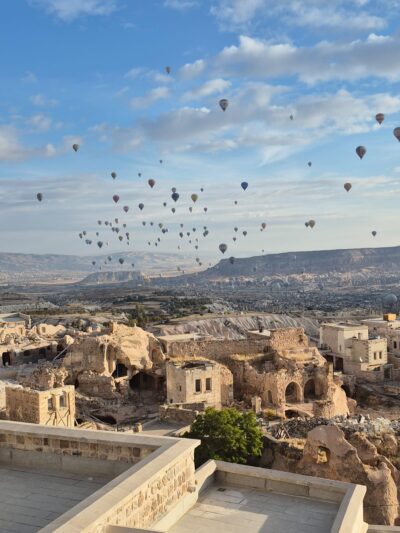
The 14th forum of the Cultural Routes of the Council of Europe, organised and hosted by Türkiye Tourism Promotion and Development Agency (TGA) and the Culture and Tourism Ministry, was held in Cappadocia between 22nd and 24 October, 2025. The theme was Cultural Routes and Landscapes; with the fairy chimneys of Cappadocia all around, it was a fit way to remember the 25th anniversary of the Landscape Convention. As well as visiting the Unesco sites of Cappadocia, with their painted churches, the many guests enjoyed visiting the Güray Museum, set in a specially excavated cave, and activities ranging from wine-tasting to trekking. The main pupose of the meeting was to emphasise the sensitivity of European landscapes and their associated Cultural Routes, at a time of climate change. Speakers also suggested new ways to interpret heritage and build relationships between the rural inhabitants of the countryside and the flow of tourists.
The annual meeting is a chance for existing routes and experts to present their routes and showcase any progress they have made. Routes are of three types:
* linear routes, which are mainly continuous walking routes, often following pilgrim trails and crossing several adjacent countries. The Via Francigena was represented; it makes use of the network of French, Swiss and Italian way-marked paths and country roads, maintained by their respective national hiking organisations, to lead walkers to Rome, and from there on to southern Italy.
* Cluster routes are centred around important themed locations in several countries and usually include local walking itineraries. Iter vitis (the wine route) is an example of these, and Cappadocia forms an ideal location to take part in this themed route. The Routes of Transhumance is another example, and Turkiye’s Efeler Yolu, near Izmir, has recently joined this route. Simone Messina and Ece Pakkanlılar presented this interesting theme based on traditional shepherd lifestyles, now badly affected by climate change and dying out around much of the Mediterranean.
* Other routes are based on individual buildings or sites and the Route of Historic Cafes is an example.
As well as the main agenda, the scientific experts who advise the creators of the routes held a side meeting, as did the administrative representatives of each country. There were the usual official welcomes and protocol speeches but they were kept mercifully short. The conference was extremely formal in presentation, not allowing interesting speakers to take questions from the floor. The time-pressure and lack of innovation in the speakers was disappointing; it might have been better to split parts of the conference into smaller interest groups to allow themes to be developed and discussed less formally. Several delegates were there to obtain advice and lobby for support in submitting their routes for certification (although this was not the purpose of the forum and was rather distracting).
Having just come from the 4th Trails and Paths conference, I found myself wondering how much the makers of especially pilgrim routes realise and acknowledge their debt to the European Hikers Association and the European Mountainering Association and their national members; for it is the volunteers of these two organisations who have created Europe’s superb trail and path network, way-marked it, maintain it, map it and innovate digital methods of recording the trails and all that goes on along them. There is no formal coordination between the Cultural Routes of the CofE and these organisations; no exchange of techniques of mapping or maintenance, no statistical exchange, and no financial support for the volunteers. The profile of the two groups is very different; the hikers and mountaineers are practical, active people and often ennablers of the service providers along the route. The Culture Route experts are often academics, keen to pursue their own research into some aspect of culture or history but adding little to the daily lives of the people who earn a living along the routes.
While these two profiles should complement and reinforce each other, that can only happen if the individual Cultural Routes of the CofE which use walking routes and the parent organisation in Luxembourg make an effort to develop in parallel relationships with local hiking and mountaineering clubs and formal cooperation agreements with the hiking and mountaineering federations. The aim of the cooperation could be to incorporate historical and cultural data in the mapping apps which present data to the user public.
Trails and routes are features of the landscape which have developed over thousands of years. They are logical lines of best fit linking settlements. Few settlements have moved over time; they may decline or increase in importance, but the location and the course of the paths between them remain. It’s only since we switched to motorised transport that paths which have been in use for thousands of years have been bypassed by wider, less steep, longer asphalt roads. Collecting a picture of walking paths and trails over the course of time would protect a deep cultural tradition which, except in mountain or underpopulated areas, is being swept away. Digitalisation of trails and routes could be expanded to both record and present historic data on the places where we walk.
When we walk paths and trails we literally walk in the footsteps of previous populations. Current technology combined with the knowledge and skills of the two user groups could create a picture of the people who walked before us.
Kate Clow







Write a comment: